skip to main |
skip to sidebar
 Not in my wildest dreams would I would have predicted that what happened today could happen.
England spent two sessions crawling from 1/59 to 129 all out: 30 runs in the pre-lunch, 40 in the post-lunch session would have been dull watching had not wickets kept falling almost a rapidly as those runs were scored.
Australia were set a fourth innings target of 166 in 36 overs. In limited overs cricket this would normally be considered to be achievable, provided too many early wickets weren't lost.
And so it happened today.
England threw the game away with some inept batting and running between wickets. Australia regrouped powerfully, grasping the nettle and the opposition by the throat to ease home comfortably by 6 wickets.
It will be very difficult to keep the series alive now, and England will be glad of a few days' respite before battle is rejoined in Perth.
Scorecard.
I've just come across The pen is edgier than the blade blog.
David Fine is an English poet who is travelling around Australia following the Tests and writing poetry and other observations about the Tests and his travels. He is funded, albeit on a modest scale (backpacker accommodation no corporate boxes), by the English Arts Council. Yes, Australian readers, you read that correctly: I could go on about why an Australian arts funding body hasn't done something similar, but I won't. Instead I'll just recommend that you read, and for future reference bookmark, the site.
He's just posted today's piece, which includes two poems, one of which celebrates Matthew Hoggard's achievement with the ball over the last three days. A brief sample (apologies if I've breached copyright):
You climb each hill, break its back before
it breaks yours, seven times
for one hundred and nine long runs, dogged
against these hounds you never let off the leash.
David also has another blog Blog Before Wicket.
His email address is david@fineandandy.co.uk.
I think of N&D as a modest blog but after reading David's work I understand how much I have to be modest about.
As the temperature rises (today it was 29 degrees, with 33 forecast for tomorrow) the widely predicted deterioration of the pitch hasn't happened, so the second Test is heading for a draw.
There were several good things about today, especially Michael Clarke's century, Matthew Hoggard's bowling and Adam Gilchrist's highest score against England since January 2003.
Clarke's elegant innings should ensure a guaranteed place for him in the team for the rest of the series.
I'd thought that a bowler of Hoggard's type would be more successful in the second innings, but he gave a masterclass in how to bowl in unfavourable conditions. He's probably glad that there's unlikely to be a second innings for him to bowl in and even gladder that there's over a week between this Test and the next.
Gilchrist returned to form with an innings in which began watchfully, then accelerated into one day mode until he was, just as it looked as if a century was there for the taking, caught on the leg boundary to give Ashley Giles his only wicket.
Australia eventually reached 513, by which time too much of the match had gone to allow either side much of a chance of winning. England's second innings began slowly, and they reached 1/53 at stumps, far enough ahead to prevent defeat, but not far enough ahead to think about a declaration tomorrow which would give them time to bowl Australia out.
Tomorrow's play, barring miracles, will almost certainly be centre wicket practice for both sides. I intend to go, but won't be expecting anything out of the ordinary.
Scorecard.
PS Sorry about not posting any photos for last two days. Hope to post a small retrospective selection tomorrow.
Australia struggled against some tight English bowling on a wicket which had been written off by most commentators as too flat to offer any hope of a breakthrough leading to a victory. Matthew Hoggard proved the pundits wrong by taking 4/76. Flintoff and Harmison bowled with sufficient attitude to make the batsmen watch them carefully, while the other bowlers were steady, if milkable.
Ponting and Hussey retrieved an early collapse, the captain adding more than another hundred runs after being dropped in the outfield by Giles off a skier.
Scorecard.
England built on yesterday's substantial start, batting through the day which became increasingly sunnier for them, both literally and metaphorically. They declared at 6/551 and had Australia 1/28 at stumps.
Today's play was an amplification of yesterday's: Paul Collingwood made the two runs he needed for his century, and then batted on slowly but proficiently in partnership with Kevin Pietersen, who played more memorable strokes more often without pulling ahead on the scorecard. The Australian bowling was tidy and at times threatening, yet no wicket fell until the penultimate ball before tea when a tired Collingwood was caught behind off Stuart Clark for 206. His 310 run partnership with Pietersen set many new records but more importantly gave England some hope of a victory and a reasonable expectation of a draw.
The two innings were each of extremely high quality, yet different in character. As many others will doubtless say, the two men complemented each other. In temperament (but not technique) Collingwood reminds me of Ken Barrington. Pietersen is much more the stylist but he didn't keep on the attack throughout: having reached his century he concentrated on countering Shane Warne's leg theory with pad play. The pitch remained flat but the bowling was better than the figures, apart from Stuart Clark's, indicated. IMO Brett Lee was the best over the day: he was the only one whose pace and bounce troubled Collingwood. The Australians kept up the pressure in the field: I thought that England might have turned a few more twos into threes and threes into fours, but when Ricky Ponting ran out Pietersen going for his 159th run (which umpire Bucknor was in no position to judge), I saw the wisdom of their earlier caution.
After the big partnership was broken wickets fell more frequently. Andrew Flintoff and Ashley Giles hit out robustly before captain Flintoff imperiously swatted a boundary, which took the total past 550, and declared.
Stephen Harmison had measured out his run up when Flintoff made a last second decision to open the bowling himself. This was more than justified when he had Justin Langer caught in the gully. In the final minutes of the day Harmison loosened up vigorously and ostentatiously but the last two overs were bowled by the captain and Matthew Hoggard, to whom wicketkeeper Jones stood up to the stumps. To paraphrase Dr Johnson, I was not surprised to see it done, but would be surprised to see it done well. As for Harmison, it goes without saying that he will need to perform well in the first innings if England are to challenge for victory. I can't see Anderson or Giles doing much on the wicket in its present state.
Other observations
# Should McGrath have played? No. Is he finished as a test bowler? After his Gabba performance I wouldn't write him off but his injury problems may make it hard for him to come back.
# Is Warne finished? No, but he shouldn't have to bowl so much (and so negatively).
# The balance of Australia's team is wrong. Four bowlers aren't enough given (1) the strength of the England batting and (2) the current standard of pitches. Michael Clarke is a Darren Lehmann-style batsman who can bowl a bit, then so are Andrew Symonds and Shane Watson. Perhaps a specialist bowler should be included with Brett Lee promoted to no 7.
# Brett Lee bowled better than his figures indicated. He's the type of bowler who will always concede runs but is always capable of taking a wicket against the run of the play.
# I need to revise my opinion of Richie Benaud's state of heaslth. Before the start of play he walked off the ground with a sprightliness which belied his years. Anyone who listens to him commenting on Channel 9 will know that he remains alert and incisive in his comments : truly the doyen of commentators.

 Incitement to racial hatred? One trumpeter who was allowed to play
For some interesting analysis of the first day's play see Telegraph.co.uk, particularly "The Analyst and the Aussie", in which Simon Hughes and Terry Jenner discuss the day's play. For a view of events beyond the boundary, including a comment about how well behaved the large crowd (inc the Barmy Army) were, see Scott Heinrich of the BBC's blog entry.
Beer match
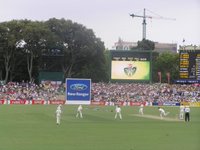
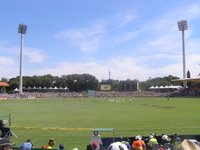 England won the toss, batted and reached 3/266 in 90 overs of tight, though only intermittently scintillating, cricket.
As the weather changed from sunny and warm to overcast and cool, so did England's persistence pay off. 2/45 was not a good start, especially as both Andrew Strauss and Alistair Cook had looked relatively comfortable until their respective dismissals. Bell and Collingwood showed what could be done with a partnership of 113 for the third wicket, and after Bell's dismissal from an unwise pull shot which went straight up in the air, Pietersen joined Collingwood and the pair gradually accelerated to stumps, when the former was 60 and the latter 98.
Australia's bowling today, apart from Stuart Clark who was underbowled, some pre-lunch spin from Shane Warne and a few fiery deliveries from an often wayward Brett Lee (his wicket taking over also conceded 12 runs) , did not look especially penetrative. It did though keep England in check reasonably well, and might have done even better had Stuart Clark instead of Michael Clarke (who bowled 11 overs of left arm spin which the batsmen played comfortably) been given more overs when Pietersen came to the wicket.
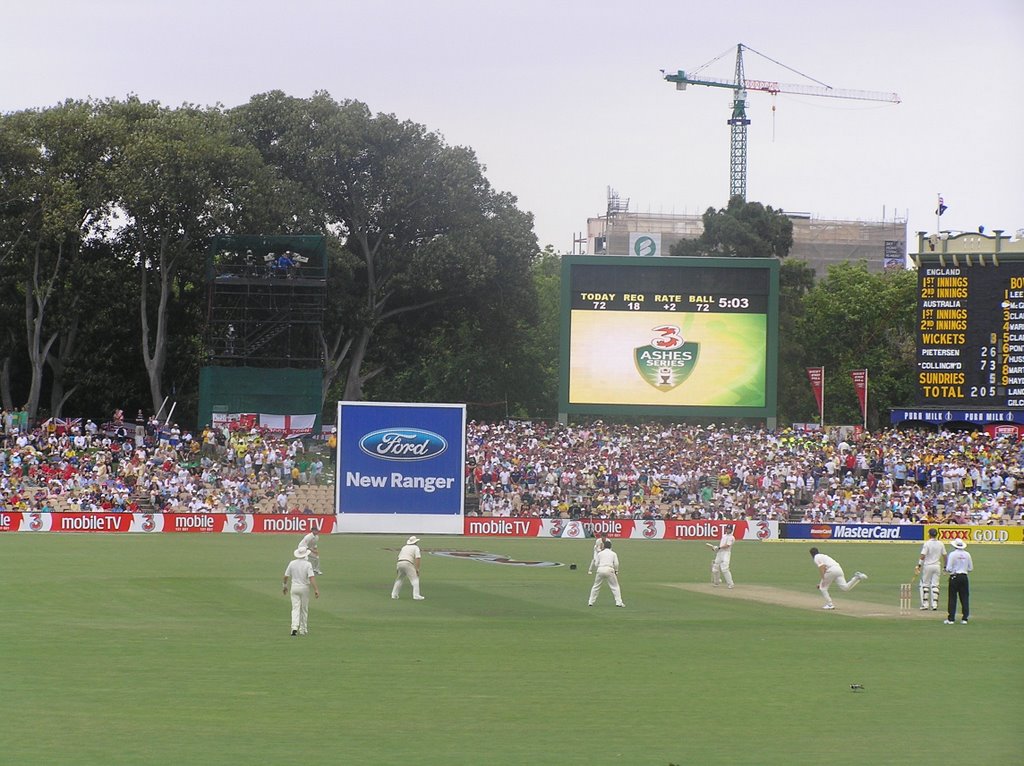
Ricky Ponting's tactics at times during the day weren't easy to fathom. As well as his choice of bowlers some of his field placings, such as those in the photo which shows Glenn McGrath bowling without a slip and with several close in fielders on the off side, raised eyebrows.
While England has had the better of the day it is too early to say that they are likely to win, or even to draw it. 266 in a day is not a 21st century Ashes score: it is more typical of the 1950s.
England need more runs: I'd say a first innings total of 450 at least, and scored relatively quickly (say by tea tomorrow) if they are to press for victory. A lower score will require 2005 standard bowling from their key bowlers. On the positive side,as Collingwood showed today, it is possible with a cool head and a sound technique, to survive on the pitch; as Pietersen showed, it is possible, with a cool head, good shot selection and some luck, to flourish.
Scorecard.