As the temperature rises (today it was 29 degrees, with 33 forecast for tomorrow) the widely predicted deterioration of the pitch hasn't happened, so the second Test is heading for a draw.
There were several good things about today, especially Michael Clarke's century, Matthew Hoggard's bowling and Adam Gilchrist's highest score against England since January 2003.
Clarke's elegant innings should ensure a guaranteed place for him in the team for the rest of the series.
I'd thought that a bowler of Hoggard's type would be more successful in the second innings, but he gave a masterclass in how to bowl in unfavourable conditions. He's probably glad that there's unlikely to be a second innings for him to bowl in and even gladder that there's over a week between this Test and the next.
Gilchrist returned to form with an innings in which began watchfully, then accelerated into one day mode until he was, just as it looked as if a century was there for the taking, caught on the leg boundary to give Ashley Giles his only wicket.
Australia eventually reached 513, by which time too much of the match had gone to allow either side much of a chance of winning. England's second innings began slowly, and they reached 1/53 at stumps, far enough ahead to prevent defeat, but not far enough ahead to think about a declaration tomorrow which would give them time to bowl Australia out.
Tomorrow's play, barring miracles, will almost certainly be centre wicket practice for both sides. I intend to go, but won't be expecting anything out of the ordinary.
Scorecard.
PS Sorry about not posting any photos for last two days. Hope to post a small retrospective selection tomorrow.
Monday, December 04, 2006


Sunday, December 03, 2006
Modest Australian recovery but draw still the likeliest result
Australia struggled against some tight English bowling on a wicket which had been written off by most commentators as too flat to offer any hope of a breakthrough leading to a victory. Matthew Hoggard proved the pundits wrong by taking 4/76. Flintoff and Harmison bowled with sufficient attitude to make the batsmen watch them carefully, while the other bowlers were steady, if milkable.
Ponting and Hussey retrieved an early collapse, the captain adding more than another hundred runs after being dropped in the outfield by Giles off a skier.
Scorecard.
Ponting and Hussey retrieved an early collapse, the captain adding more than another hundred runs after being dropped in the outfield by Giles off a skier.
Scorecard.
Saturday, December 02, 2006
England's big day on the field
England built on yesterday's substantial start, batting through the day which became increasingly sunnier for them, both literally and metaphorically. They declared at 6/551 and had Australia 1/28 at stumps.
Today's play was an amplification of yesterday's: Paul Collingwood made the two runs he needed for his century, and then batted on slowly but proficiently in partnership with Kevin Pietersen, who played more memorable strokes more often without pulling ahead on the scorecard. The Australian bowling was tidy and at times threatening, yet no wicket fell until the penultimate ball before tea when a tired Collingwood was caught behind off Stuart Clark for 206. His 310 run partnership with Pietersen set many new records but more importantly gave England some hope of a victory and a reasonable expectation of a draw.
The two innings were each of extremely high quality, yet different in character. As many others will doubtless say, the two men complemented each other. In temperament (but not technique) Collingwood reminds me of Ken Barrington. Pietersen is much more the stylist but he didn't keep on the attack throughout: having reached his century he concentrated on countering Shane Warne's leg theory with pad play. The pitch remained flat but the bowling was better than the figures, apart from Stuart Clark's, indicated. IMO Brett Lee was the best over the day: he was the only one whose pace and bounce troubled Collingwood. The Australians kept up the pressure in the field: I thought that England might have turned a few more twos into threes and threes into fours, but when Ricky Ponting ran out Pietersen going for his 159th run (which umpire Bucknor was in no position to judge), I saw the wisdom of their earlier caution.
After the big partnership was broken wickets fell more frequently. Andrew Flintoff and Ashley Giles hit out robustly before captain Flintoff imperiously swatted a boundary, which took the total past 550, and declared.
Stephen Harmison had measured out his run up when Flintoff made a last second decision to open the bowling himself. This was more than justified when he had Justin Langer caught in the gully. In the final minutes of the day Harmison loosened up vigorously and ostentatiously but the last two overs were bowled by the captain and Matthew Hoggard, to whom wicketkeeper Jones stood up to the stumps. To paraphrase Dr Johnson, I was not surprised to see it done, but would be surprised to see it done well. As for Harmison, it goes without saying that he will need to perform well in the first innings if England are to challenge for victory. I can't see Anderson or Giles doing much on the wicket in its present state.
Other observations
# Should McGrath have played? No. Is he finished as a test bowler? After his Gabba performance I wouldn't write him off but his injury problems may make it hard for him to come back.
# Is Warne finished? No, but he shouldn't have to bowl so much (and so negatively).
# The balance of Australia's team is wrong. Four bowlers aren't enough given (1) the strength of the England batting and (2) the current standard of pitches. Michael Clarke is a Darren Lehmann-style batsman who can bowl a bit, then so are Andrew Symonds and Shane Watson. Perhaps a specialist bowler should be included with Brett Lee promoted to no 7.
# Brett Lee bowled better than his figures indicated. He's the type of bowler who will always concede runs but is always capable of taking a wicket against the run of the play.
# I need to revise my opinion of Richie Benaud's state of heaslth. Before the start of play he walked off the ground with a sprightliness which belied his years. Anyone who listens to him commenting on Channel 9 will know that he remains alert and incisive in his comments : truly the doyen of commentators.
Today's play was an amplification of yesterday's: Paul Collingwood made the two runs he needed for his century, and then batted on slowly but proficiently in partnership with Kevin Pietersen, who played more memorable strokes more often without pulling ahead on the scorecard. The Australian bowling was tidy and at times threatening, yet no wicket fell until the penultimate ball before tea when a tired Collingwood was caught behind off Stuart Clark for 206. His 310 run partnership with Pietersen set many new records but more importantly gave England some hope of a victory and a reasonable expectation of a draw.
The two innings were each of extremely high quality, yet different in character. As many others will doubtless say, the two men complemented each other. In temperament (but not technique) Collingwood reminds me of Ken Barrington. Pietersen is much more the stylist but he didn't keep on the attack throughout: having reached his century he concentrated on countering Shane Warne's leg theory with pad play. The pitch remained flat but the bowling was better than the figures, apart from Stuart Clark's, indicated. IMO Brett Lee was the best over the day: he was the only one whose pace and bounce troubled Collingwood. The Australians kept up the pressure in the field: I thought that England might have turned a few more twos into threes and threes into fours, but when Ricky Ponting ran out Pietersen going for his 159th run (which umpire Bucknor was in no position to judge), I saw the wisdom of their earlier caution.
After the big partnership was broken wickets fell more frequently. Andrew Flintoff and Ashley Giles hit out robustly before captain Flintoff imperiously swatted a boundary, which took the total past 550, and declared.
Stephen Harmison had measured out his run up when Flintoff made a last second decision to open the bowling himself. This was more than justified when he had Justin Langer caught in the gully. In the final minutes of the day Harmison loosened up vigorously and ostentatiously but the last two overs were bowled by the captain and Matthew Hoggard, to whom wicketkeeper Jones stood up to the stumps. To paraphrase Dr Johnson, I was not surprised to see it done, but would be surprised to see it done well. As for Harmison, it goes without saying that he will need to perform well in the first innings if England are to challenge for victory. I can't see Anderson or Giles doing much on the wicket in its present state.
Other observations
# Should McGrath have played? No. Is he finished as a test bowler? After his Gabba performance I wouldn't write him off but his injury problems may make it hard for him to come back.
# Is Warne finished? No, but he shouldn't have to bowl so much (and so negatively).
# The balance of Australia's team is wrong. Four bowlers aren't enough given (1) the strength of the England batting and (2) the current standard of pitches. Michael Clarke is a Darren Lehmann-style batsman who can bowl a bit, then so are Andrew Symonds and Shane Watson. Perhaps a specialist bowler should be included with Brett Lee promoted to no 7.
# Brett Lee bowled better than his figures indicated. He's the type of bowler who will always concede runs but is always capable of taking a wicket against the run of the play.
# I need to revise my opinion of Richie Benaud's state of heaslth. Before the start of play he walked off the ground with a sprightliness which belied his years. Anyone who listens to him commenting on Channel 9 will know that he remains alert and incisive in his comments : truly the doyen of commentators.
Friday, December 01, 2006
The trumpet did not sound: photos and observations from the Adelaide Oval


Incitement to racial hatred? One trumpeter who was allowed to play
For some interesting analysis of the first day's play see Telegraph.co.uk, particularly "The Analyst and the Aussie", in which Simon Hughes and Terry Jenner discuss the day's play. For a view of events beyond the boundary, including a comment about how well behaved the large crowd (inc the Barmy Army) were, see Scott Heinrich of the BBC's blog entry.
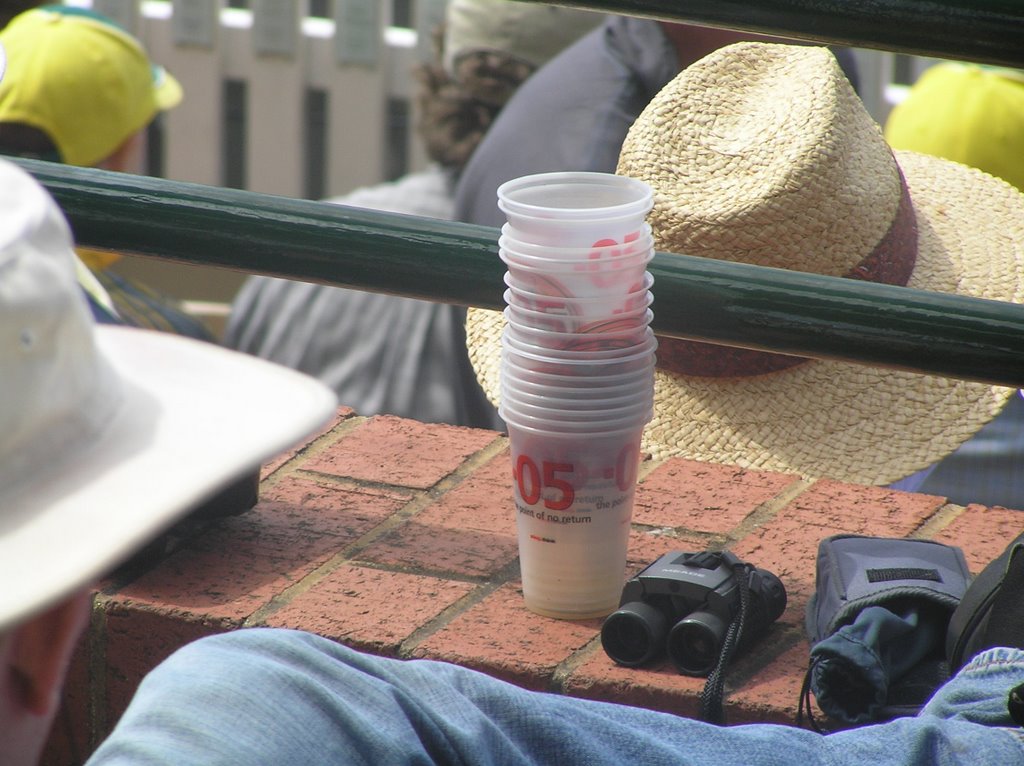
Beer match
Like the 1950s: Second Test Day 1
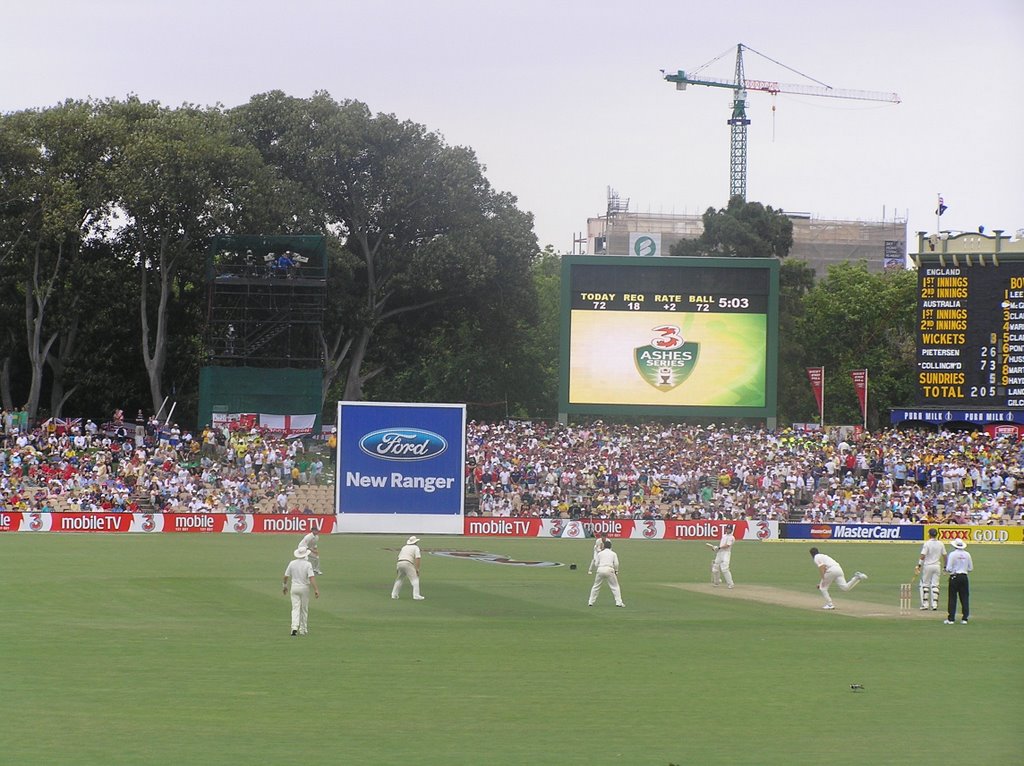

England won the toss, batted and reached 3/266 in 90 overs of tight, though only intermittently scintillating, cricket.
As the weather changed from sunny and warm to overcast and cool, so did England's persistence pay off. 2/45 was not a good start, especially as both Andrew Strauss and Alistair Cook had looked relatively comfortable until their respective dismissals. Bell and Collingwood showed what could be done with a partnership of 113 for the third wicket, and after Bell's dismissal from an unwise pull shot which went straight up in the air, Pietersen joined Collingwood and the pair gradually accelerated to stumps, when the former was 60 and the latter 98.
Australia's bowling today, apart from Stuart Clark who was underbowled, some pre-lunch spin from Shane Warne and a few fiery deliveries from an often wayward Brett Lee (his wicket taking over also conceded 12 runs) , did not look especially penetrative. It did though keep England in check reasonably well, and might have done even better had Stuart Clark instead of Michael Clarke (who bowled 11 overs of left arm spin which the batsmen played comfortably) been given more overs when Pietersen came to the wicket.
Ricky Ponting's tactics at times during the day weren't easy to fathom. As well as his choice of bowlers some of his field placings, such as those in the photo which shows Glenn McGrath bowling without a slip and with several close in fielders on the off side, raised eyebrows.
While England has had the better of the day it is too early to say that they are likely to win, or even to draw it. 266 in a day is not a 21st century Ashes score: it is more typical of the 1950s.
England need more runs: I'd say a first innings total of 450 at least, and scored relatively quickly (say by tea tomorrow) if they are to press for victory. A lower score will require 2005 standard bowling from their key bowlers. On the positive side,as Collingwood showed today, it is possible with a cool head and a sound technique, to survive on the pitch; as Pietersen showed, it is possible, with a cool head, good shot selection and some luck, to flourish.
Scorecard.
Thursday, November 30, 2006
Killjoys wait to pounce on media
In today's Advertiser Geoff Roach bemoans the stringent pass controls with which all the media, including the large English contingent visiting Adelaide for the Test (or is it the opportunity to visit the Barossa and McLaren Vale?) have to comply:
At latest count, some 130 accredited journos - most of them blow-ins from Blighty - will descend on Adelaide Oval tomorrow intent on relaying every action and nuance to their readers, listeners and watchers. Because of the resultant crush, many will not even be allocated a seat.
At latest count, some 130 accredited journos - most of them blow-ins from Blighty - will descend on Adelaide Oval tomorrow intent on relaying every action and nuance to their readers, listeners and watchers. Because of the resultant crush, many will not even be allocated a seat.
But all have been issued with a chillingly comprehensive document - called the Media Accreditation Terms and Conditions (MATC) - which specifies where they can go and what they can and cannot do, wear, eat, photograph, etc. etc. Hence my nervousness.
Fair dinkum, if you think Cricket Australia's restrictions on paying spectators are fearsome - no beach balls, musical instruments, laughter or other visible signs of fun - you should have gander at the MATC.
Having read and re-read the document several times, I fear - no I know - I may well blunder into breaching some of its more obscure tenets. In which case the security force - which, apparently, is of similar number to that of the fourth estate - may well banish me.
Take the matter of attire. Jeans, says the MATC, are acceptable Oval clobber for journos - but only if they are not torn or frayed.
Female journos are, however, required to be "neat and casual at all times" and may not wear "rubber thongs or revealing attire."
Conversing with friends or family is also fraught with danger. According to MATC, "SACA security has been instructed to escort any children and friends from the media facilities."
Being a total technical troglodyte, I am also a monty to be in breach of stipulations relating to internet sites, mobile phones, podcasts and strangely named electronic paraphernalia of which I have no understanding.
Accordingly, to avoid disgrace and embarrassment, I intend to behave at this Test match precisely as I have on previous occasions.
That is, I will avoid sitting anywhere near media facilities or security personnel; observe the first session from the garden seats in the Members'; and subsequently adjourn to the tennis courts' refreshment area in order to garner the wisdom of those who know a damn sight more about cricket than do I. See you there.
The MATC seems to be an expanded version of the Cricket Australia conditions of entry (probably minus the drinking restrictions), with a leavening (if that's the appropriate term) of the SACA members' dress code. Geoff at least can escape, as many other members will do, to the hospitality facilities behind the stands where you can eat, drink and watch the play (with uncensored replays) on the TV sets there.
I'll wait to hear about the first journalist to be evicted for breaching the MATC.
Wednesday, November 29, 2006
" Behave, but have fun": 250 strong security force mobilised to protect esky and beach ball exclusion zone
Today The Advertiser's print edition ran an article on p7 with the headline "Behave, but have fun", which was reproduced on the companion Adelaide Now website as "Have fun - but behave".
A 250 strong security force comprising more than 90 police and 140 security guards will be deployed not, as you might be forgiven for thinking, to assist in the restoration of order somewhere in the South Pacific "arc of instability", but to exercise zero tolerance of the expected 30,000+ crowd at the Test.
SACA chief executive Mike Deare said the measures, which had been eight months in planning, were designed to increase patrons' enjoyment of the cricket...."Because of the huge attendance and the strong desire of the International Cricket Council and Cricket Australia, as well as my own board of management, to ensure that everybody has an enjoyable day, we have significantly increased security activities this season. Hopefully there will be no suppression of the crowd's enthusiasm. We are certainly not intending to do that . . . we're intending to do exactly the opposite by making sure those unpleasant incidents . . . don't occur."
Chief Inspector John Gerlach, the officer in charge of the operation, said police would have zero tolerance. "We would be urging people to have fun at the cricket but what is important is that people don't do things that interfere with the comfort and safety of other people at the event," he said.
...............
Mr Deare confirmed the Barmy Army would not be permitted to bring a trumpet into the ground. Beach balls would also be banned. The Mexican wave would be permitted but patrons seen throwing items into the air would face eviction.
Other media are picking up on the killjoy tactics employed in Brisbane: for example Gideon Haigh's Eye on the Ashes and The Surfer blogs on Cricinfo , Greg Baum in The Age , and this from the Gold Coast Bulletin, reporting on the first four days of the Brisbane Test:
People were thrown out for a whole range of sins, including blowing their own trumpet, waving the Aussie flag, trying to start a Mexican wave and even, dare we say it, inciting an 'Aussie Aussie Aussie Oi Oi Oi' chant. A Gold Coast cricket fan was told by police to leave his seat because he was sneezing too much. True story. The last straw came when police ordered that an inflatable kangaroo, this country's national icon, be deflated or the owner would be turfed out. Ironically, the fella who somehow smuggled a blow-up doll into the stadium evaded the clutches of about six wallopers.
The fun police have simply gone too far. They are getting the Barmy Army mixed up with the British soccer hooligans.The stiff suits in Brisbane have turned the Gabba into a prison for spectators while at Surfers Paradise, an hour's drive away, 18-year-old school leavers are partying in style, with few arrests.It's not often that the Poms have a legitimate beef but by separating the English spectators at the Gabba, Cricket Australia erred badly.The Barmy Army is one of the best-behaved groups of spectators in the world. They are an extremely well-organised group made up of mostly middle-class Poms who simply want to have a beer and a laugh, combining their love of cricket with an Aussie holiday. By splitting them, denying them the chance to sing en masse, the fun police took away a lot of the atmosphere which has become part and parcel of an Ashes series between the two countries.
Update 30 November: Today's Australian has an editorial "Leave fun in cricket" which now compares SA unfavourably with more tolerant cricket administrations elsewhere:Heavy handed fun police at Brisbane's Gabba who threw Barmy Army trumpeter Billy Cooper out of the ground on the first day of Australia's Test against England didn't do spectators any favours...Now the South Australian Cricket Association has also shown it shares the Gabba's killjoy colours by banning Mr Cooper's trumpet from the second Test...He will be allowed to rejoin the fun when the cricket circus moves on to Perth and Sydney.
South Australia struggles to compete for a larger share of the international tourism market, and it can't help to have us branded as a killjoy state. Queensland has many other attractions so will be able to deflect the criticism more readily ("killjoy one day, beautiful the next"), leaving South Australia with a tougher job to counter the negative reputation.
The Australian has just posted a story"Banned bugler ' culturally relevant'"where an Adelaide University professor of musicology has added his voice to the swelling chorus of criticism.
Subscribe to:
Posts (Atom)

